Monster Cards
The primary card type. Monsters are placed on the grid, participate in conflicts, flip opponent cards, and score points.
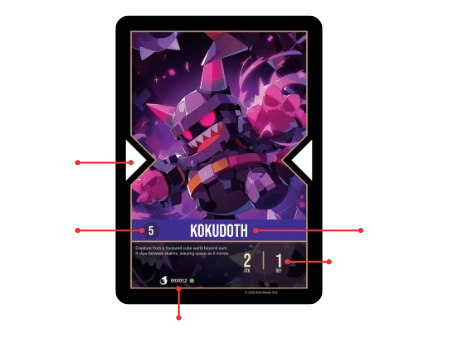
Stats
Cost
The number of credits you pay to play this card active (face-up) from your hand. You cannot play a monster you cannot afford; credits cannot go below zero through a hand play.
Playing a monster covered (face-down) defers the cost until the following turn. See Playing Cards.
ATK (Attack)
Used during conflicts. When your arrow points at an opponent card, your ATK is compared against their DEF. If your ATK equals or exceeds their DEF, the opponent card is flipped to face you (it becomes your point) or destroyed if its DEF reaches 0.
ATK is also the currency for the Resurrection ability: you can revive cards from the graveyard up to your ATK in combined cost.
DEF (Defense)
The card's durability in conflicts. Each time an opponent arrow hits this card, DEF is reduced by the attacker's ATK. When DEF reaches 0 the card is destroyed and sent to the graveyard.
Arrows
Each monster has between 1 and 8 directional arrows pointing in the 8 compass directions (N, NE, E, SE, S, SW, W, NW). Arrows define what happens when you place or flip a card: each arrow that points at an adjacent card triggers a conflict or activates an ability.
Some arrow slots carry special ability icons instead of plain arrows. These trigger abilities rather than conflicts when pointing at adjacent cells. See Arrows and the Ability Reference.
Element
Every monster belongs to one of six elements. The element determines which ability the card's ability arrows can trigger. Under the Color Synergy rule (currently Testing), adjacent same-element blocks provide ATK/DEF bonuses.
There are no deck-building restrictions by element. See Elements for the full list.
Rarity
Cards are classified as Common, Uncommon, Rare, or Epic. Rarity reflects card power level and affects how frequently a card appears in booster packs. It has no effect on legality; all rarities are allowed in any quantity (subject to the 4-copy per-monster-name limit in deck construction).
Scoring
Only monster cards that are active (face-up) and in the 5×5 main zone count toward your score. A card flipped toward you counts as your point. Covered monsters and monsters in the out zone do not count. See Scoring.