Conflicts & Flip
Conflicts happen when arrows clash. Flipping happens when they don't.
What is a Conflict?
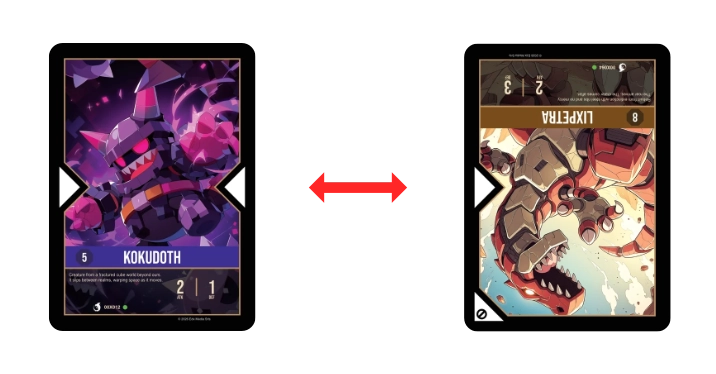
A conflict occurs when your active card has an arrow pointing toward an opponent card that also has an arrow pointing back at your card. The two arrows are "meeting" each other.
When an opponent card has an arrow pointing back at your active card, that card is said to be defending its position. A card that defends its position always triggers a conflict; it never gets flipped without a fight.
If your active card's arrow points at an opponent card that is not defending its position, there is no conflict. You flip the opponent card instead (see below).
Resolving a Conflict
Damage in a conflict is simultaneous. Both cards deal and receive damage at the same moment; there is no attacker that strikes first.
- Card A (your active card) and Card B (the opponent's defending card) deal damage at the same time.
- Card B's DEF is reduced by Card A's ATK.
- Card A's DEF is reduced by Card B's ATK.
- Any card reaching 0 DEF is destroyed immediately and sent to the graveyard.
Card Destroyed Mid-Conflict
If your active card reaches 0 DEF during a conflict, it is destroyed immediately. The current Activation Sequence ends; no further conflicts, flips, or abilities are resolved. If this card was part of a chain, the sequence returns to the previously activated card in the chain and continues from where it left off.
If an opponent card reaches 0 DEF, it is destroyed and the sequence continues normally.
Damage Carries Over
DEF reductions accumulate for the entire turn. If your active card takes 3 DEF damage in the first conflict, it enters the second conflict already at reduced DEF. This also affects abilities: Firestorm uses a card's current DEF when distributing damage. Future conflicts triggered by reactivations within the same turn also use the accumulated damage values.
Multiple Conflicts
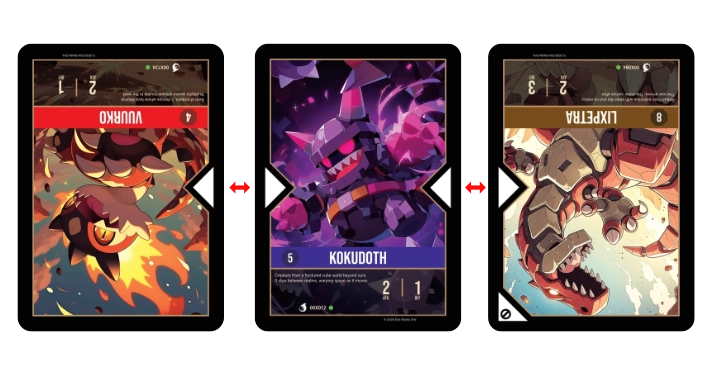
Your active card may have multiple arrows pointing at multiple opponent cards that are defending their positions. Each is a separate conflict. You resolve them in any order you choose, one at a time.
Flipping Cards
After all conflicts are resolved (and the active card survived), you flip opponent cards. An opponent card in the direction of one of your arrows is flipped if:
- It is not defending its position (no arrow pointing back at your active card), and
- Your active card survived all its conflicts.
Flipping means rotating the card 180 degrees so it now faces you. It counts as your point in the score.
Flipping Does Not Consume Abilities
Flipping an opponent card is separate from using arrow abilities. Two valid sequences exist for the same arrow:
- Use the ability in Ability Phase 1, then flip the card (if it is not defending its position) during the Flip step.
- Let the card get flipped first, then use that same arrow's ability in Ability Phase 1 or Phase 2.
A normal arrow that flips a card does not "use up" an ability; it has none. An ability arrow that flips a card can still fire its ability in the ability phase.